
How to Make $1,000 Per Month from a YouTube Music Channel

There is no shortage of videos promising "$10,000/month passive income with AI music channels." Most of them gloss over the actual math. This guide does the opposite: we break down exactly what it takes to reach $1,000/month from a YouTube music channel, with realistic numbers, specific strategies, and an honest look at the timeline.
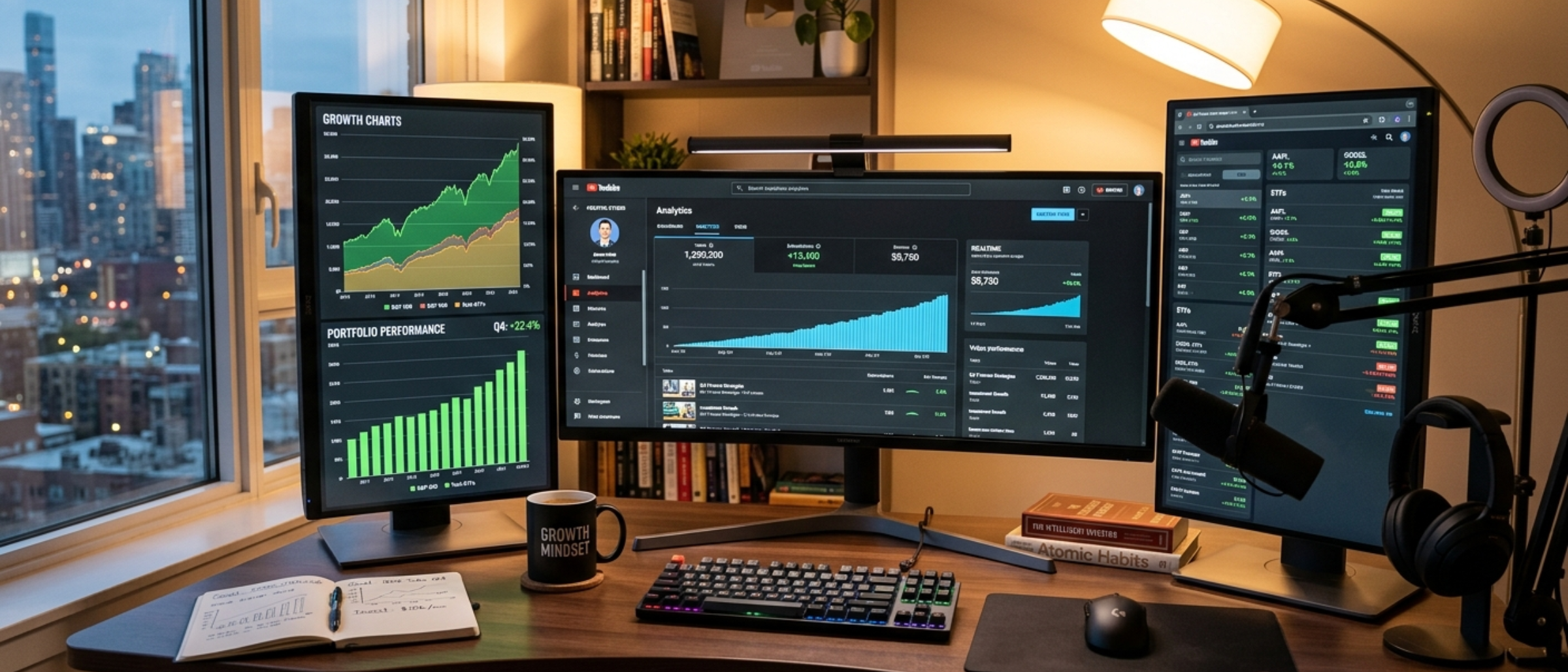
$1,000/month is not life-changing money, but it is a meaningful milestone. It proves the model works, it covers platform costs and tools, and it provides a foundation you can scale. Most importantly, it is actually achievable.
The Revenue Math: How YouTube Pays Music Channels
YouTube pays creators through the YouTube Partner Program (YPP) based on ad revenue. The metric that matters is RPM (Revenue Per Mille) -- how much you earn per 1,000 views after YouTube takes its 45% cut.
CPM vs. RPM
CPM (Cost Per Mille) is what advertisers pay per 1,000 ad impressions. RPM is what you actually receive per 1,000 video views, after YouTube's cut and factoring in that not every view generates an ad impression.
For music channels, typical RPM ranges:
- Low RPM ($0.50-$1.50): Instrumental beats, short tracks, audiences primarily in Southeast Asia, South America, or Africa. High view counts but low per-view revenue.
- Medium RPM ($1.50-$3.00): Ambient, lo-fi, study music with a mixed global audience. The most common range for music channels.
- High RPM ($3.00-$6.00): Meditation, sleep, and wellness music targeting US/UK/Canada/Australia audiences. Long watch sessions mean more mid-roll ads.
- Premium RPM ($5.00-$10.00+): Productivity music, business-focused playlists, content that attracts high-value advertising categories. Rare but achievable with the right niche targeting.
Views Needed at Different RPMs
To earn $1,000/month:
| RPM | Monthly Views Needed |
|---|---|
| $1.00 | 1,000,000 |
| $2.00 | 500,000 |
| $3.00 | 333,333 |
| $4.00 | 250,000 |
| $5.00 | 200,000 |
| $7.00 | 142,857 |
At a $2 RPM (common for study/lo-fi channels), you need 500,000 views per month. That sounds daunting, but the math gets more interesting when you consider how music channel views work.
How Music Channel Views Compound
Unlike commentary or vlog channels where each video has a brief spike and then dies, music tracks accumulate views steadily over months and years. A sleep music track published today might get 50 views in its first week, 200 views in its first month, and then settle into 10-20 views per day indefinitely.
This is the compounding effect that makes music channels work:
Month 1: 20 tracks published, each averaging 5 views/day = 100 views/day = 3,000/month Month 3: 60 tracks, each averaging 8 views/day = 480 views/day = 14,400/month Month 6: 120 tracks, each averaging 12 views/day = 1,440 views/day = 43,200/month Month 12: 240 tracks, each averaging 15 views/day = 3,600 views/day = 108,000/month Month 18: 360 tracks, each averaging 20 views/day = 7,200 views/day = 216,000/month Month 24: 480 tracks, each averaging 25 views/day = 12,000 views/day = 360,000/month
These are conservative averages. In practice, some tracks will get 0 views/day and a few breakout tracks might get 500+. But the model holds: more tracks equals more daily views, and daily views compound into monthly totals that cross the monetization threshold.
At a $3 RPM (achievable with meditation/sleep content targeting English-speaking audiences), 360,000 monthly views produces $1,080/month.
The Content Volume Strategy
The math above assumes 5 new tracks per week. That is the number that makes the timeline work within 18-24 months for most channels. Here is why volume matters and how to sustain it.
Why Volume Beats Perfection
Every track you publish is a lottery ticket in YouTube's recommendation system. Some will get picked up and recommended widely. Most will not. You cannot predict which tracks will break out, so your best strategy is to publish consistently and let the algorithm surface your winners.
Channels that publish 2 tracks per month and try to make each one perfect grow much slower than channels that publish 15-20 tracks per month at good (not perfect) quality. The algorithm needs volume to learn your audience, and your catalog needs depth to generate meaningful cumulative views.
Sustainable Production With AI
Producing 5 tracks per week manually is a full-time job. With AI-assisted tools, it becomes a manageable side project:
Without AI (traditional workflow):
- Compose and produce track: 4-6 hours
- Create video visuals: 1-2 hours
- Write metadata and upload: 30 minutes
- Total per track: 6-9 hours
- Weekly time for 5 tracks: 30-45 hours
With MusicFlowAI (automated workflow):
- Configure Producer and prompt: 10 minutes (one-time setup)
- Review generated track: 5 minutes
- Adjust metadata if needed: 5 minutes
- Total per track: 10-20 minutes (most steps are automated)
- Weekly time for 5 tracks: 1-2 hours
The difference is not marginal. It is an order of magnitude. MusicFlowAI's Generation Plans can handle the entire pipeline automatically -- generating lyrics, producing audio, creating video, and publishing to YouTube on a schedule you define. Your role shifts from production to curation and strategy.
Maximizing RPM: Niche Selection
Your RPM is largely determined by three factors: your audience's geography, the advertiser categories your content attracts, and your video length (which determines mid-roll ad eligibility).
High-RPM Niches in Music
Sleep and meditation music consistently commands the highest RPMs in the music category. Advertisers in the wellness, health, and self-improvement categories pay premium rates, and these audiences skew toward higher-income English-speaking countries.
Study and productivity music attracts education and software advertisers, which are high-value categories. Content targeting college students and professionals performs well.
Workout and gym music attracts fitness and supplement advertisers. CPMs are strong, though the audience prefers shorter tracks (30-60 minutes) which limits mid-roll potential.
Lo-fi and chill beats have massive audiences but more moderate RPMs. The volume potential compensates for lower per-view revenue.
Video Length and Mid-Roll Ads
Videos over 8 minutes are eligible for mid-roll ads. For music channels, this is critical. A 3-hour sleep music track can serve multiple mid-roll ads, dramatically increasing per-view revenue compared to a 5-minute single.
Practical approach:
- Publish primarily long-form content (1-3 hours) for maximum ad revenue per view
- Supplement with shorter tracks (15-30 minutes) for playlist variety
- Create YouTube Shorts from your best tracks for discovery (Shorts have their own revenue model)
A single 3-hour track at $5 CPM might earn $0.01-0.02 per view. The same viewer watching a 5-minute track might earn $0.002 per view. The revenue difference per viewer is 5-10x for long-form content.
Diversifying Beyond AdSense
AdSense is the most straightforward revenue stream, but $1,000/month becomes easier to reach when you diversify.
Streaming Platform Distribution
Your AI-generated tracks can be distributed to Spotify, Apple Music, Amazon Music, and other streaming platforms through distributors like DistroKid or TuneCore. Per-stream revenue is small ($0.003-$0.005 per stream on Spotify), but it is incremental revenue from content you have already created.
A catalog of 200+ tracks on Spotify can generate $50-$150/month with modest streaming numbers. That is not significant alone, but combined with YouTube revenue, it moves the needle.
Licensing and Sync
Some of your tracks may be suitable for licensing to content creators, podcasters, or small businesses for use in their own videos and presentations. Platforms like Artlist, Epidemic Sound, and Pond5 accept submissions, though competition is stiff.
A more accessible approach: offer your music for free use with credit on your YouTube channel. This drives traffic back to your channel, increasing views and subscriber count, which increases AdSense revenue. The indirect revenue often exceeds what licensing would generate.
Channel Memberships and Super Thanks
Once you reach 1,000 subscribers, you can enable channel memberships. For music channels, offering members-only tracks, early access to new uploads, or ad-free listening versions can generate $100-$300/month from a loyal base of 50-100 paying members.
Super Thanks (one-time tips on videos) adds another small but consistent revenue trickle, especially on tracks that people use regularly and feel grateful for.
The Realistic Timeline to $1,000/Month
Let's map this out with honest expectations:
Months 1-3: Foundation (Revenue: $0)
- Prerequisite: reach 1,000 subscribers and 4,000 watch hours for YPP eligibility
- Publishing 5 tracks per week, building catalog and search presence
- Total catalog: ~60 tracks
- Focus: SEO optimization, niche selection, visual branding
Months 4-6: YPP Approval (Revenue: $10-$50/month)
- Most channels reach YPP eligibility in this window with consistent publishing
- Early revenue is tiny but validates the model
- Total catalog: ~120 tracks
- Focus: Analyzing which tracks perform best, doubling down on those styles
Months 7-12: Growth Phase (Revenue: $50-$200/month)
- Catalog size starts generating meaningful cumulative daily views
- Some tracks begin ranking in YouTube Search for target keywords
- Total catalog: ~240 tracks
- Focus: Long-form content, playlist optimization, thumbnail testing
Months 13-18: Acceleration (Revenue: $200-$600/month)
- Compounding effect becomes visible in analytics
- YouTube starts recommending your content more actively
- A few breakout tracks drive disproportionate views
- Total catalog: ~360 tracks
- Focus: Expanding into adjacent sub-niches, experimenting with Shorts
Months 19-24: Target Zone (Revenue: $600-$1,200/month)
- Large catalog generates 10,000+ views per day across all tracks
- Revenue stabilizes as new uploads add incrementally and older tracks maintain baseline views
- Total catalog: ~480 tracks
- Focus: Diversifying revenue streams, optimizing RPM through audience targeting
This timeline assumes 5 uploads per week consistently. It assumes average content quality -- not every track is a hit, but none are terrible. It assumes a medium-to-high RPM niche ($2-$4 RPM). And it assumes no viral breakouts, which would accelerate things significantly but cannot be relied upon.
What Separates Channels That Make It
Having watched hundreds of music channels attempt this journey, the pattern of success is clear:
Channels that reach $1,000/month:
- Published consistently for 12+ months without extended breaks
- Built a catalog of 300+ tracks
- Focused on a specific niche rather than scattering across genres
- Published long-form content (1+ hours) regularly
- Used SEO-optimized titles matching real search queries
- Treated it as a system, not a creative passion project
Channels that stalled or quit:
- Published inconsistently (bursts of activity followed by weeks of silence)
- Tried to cover too many genres
- Focused on short tracks exclusively
- Spent more time on production quality than publication frequency
- Expected results in 3-6 months and lost motivation
The pattern is not about talent or even content quality past a baseline. It is about consistency, volume, and patience. AI tools like MusicFlowAI exist specifically to make the consistency and volume parts sustainable. They do not replace your creative direction and niche strategy, but they eliminate the production bottleneck that causes most channels to publish too infrequently to reach critical mass.
$1,000/month from a YouTube music channel is real and achievable. It is not fast, it is not glamorous, and it requires showing up consistently for longer than most people are willing to. But the math works, the model is proven, and the tools to execute it have never been more accessible.